“How thick was his Irish accent?”

As my new friend Arthur (Art) Keys and I roamed through the West Virginia and western Pennsylvania countryside, exploring historical “Campbellite” sites in his SUV, we conversed about how strikingly familiar the region must have felt to the Campbell family when they arrived from Northern Ireland in the early nineteenth century. Art is a local, a western Pennsylvanian and a former student of Bethany College, where I have spent the last week doing ten-hour days in the Campbell archive. He explained to me, as he expertly negotiated hair-pin turns and narrow roads, that you can tell you’ve crossed in to Pennsylvania from West Virginia when you stop seeing rickety walking bridges built over the creeks and rivers. Art knows Campbell history well and the region even better. He knows the obscure short cuts between the wildly criss-crossing roads and his history of the local spots reach back to Campbell’s day and travel forward to include him.

Art and I were, coincidentally, in Ahorey, Ireland on the same day last summer – a spur of the moment trip for me – both travelling to visit the Ahorey Presbyterian Church where the Campbell’s ministered before moving to the United States. To this day the church is relatively unchanged. It sits on a rural hill, with a view of the lush Irish countryside not too far from Rich Hill, where the family home was and where Thomas Campbell ran a small academy.
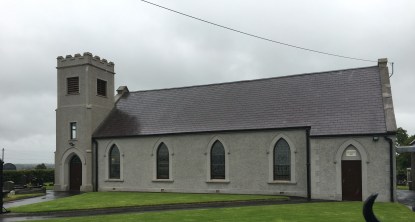
IMG_0843

Ahorey Presbyterian Church in Ahorey, Northern Ireland

The journey from Rich Hill in Northern Ireland to Washington, Pennsylvania was potentially perilous, it covered several thousand miles, and it required multiple modes of transportation. Despite the distance, life in Pennsylvania would have been a lot like home for the Campbells. The rolling hills, the deep greens of the visual landscape, the pasture lands, and, of course, the significant Scots-Irish population and the associated influence of Presbyterian Christianity would all reflect their homeland.

Too frequently Campbell is cast as a character that replaced his homeland of Ireland and his Scots-Irish ideas with America and American ones. This suggests, first of all, that “America” existed. Of course, by this time the Revolutionary war was over and the United States existed, but the new nation was in its infancy and there was certainly no consensus about what it was or what it ought to be. In fact, as Jon Butler has argued, Christianities of an increasing variety provided a sense of order in this tumultuous time. Campbell, like so many others, had a sense for what he thought America was and what it ought to be, a sense that was significantly informed by his Scots-Irish upbringing, by the place of Northern Ireland, and by the Scottish ideas he learned from his father Thomas and from a short stint, during a philosophically important time, at the University of Glasgow.

Campbell embraced his adoptive country and his own words corroborate those who argue that he substituted “American” ideals for Irish ones. But the history and again, Campbell’s own words and actions, reveal the underlying foundation of his Irish upbringing and his consistent connection to his homeland. His prescription for Christianity was equal parts Scottish Common Sense philosophy combined with the independent ethos of Seceder Presbyterianism. Even in business he depended on the place of his birth. He started a school, which was essentially the family business, and he
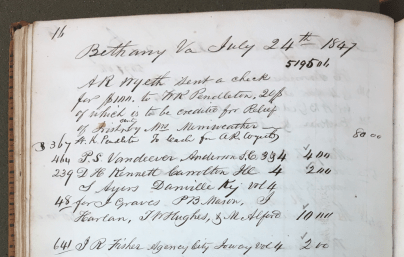
Relief of the Irish

Photo credit: James Dupey – Courtesy of T.W. Phillips Memorial Library, Bethany College Alexander Campbell Collection. Transcription: A.R. Wyeth sent a check for $100.00 to W.K. Pendleton. $20 of which is to be credited for Relief of Irish . . .

brought a shepherd from Scotland to take care of his substantial and profitable wool farm. One of the best examples, which Art shared with me in a speech he wrote for Founder’s Day at Bethany College, was Campbell’s response to the Irish famine.

Campbell raised money and traveled to Northern Ireland (as part of a larger trip) to help the Irish sufferers regardless of denominational affiliation and without a primary concern for conversion. What mattered was that they were Irish, his people, and they were suffering. Finally, the place he settled in, and used to simultaneously build a business empire and a new Christian denomination, was perhaps the most familiar place available to an Irishman in the nineteenth century United States. The American environment, more than anything, offered a relatively open market to sell a considerably Scots-Irish form of Christianity to thousands of people living in a region that is increasingly referred to as the trans-Appalachian west.

Art and I agreed that the real question is, “How thick was his Irish accent?”
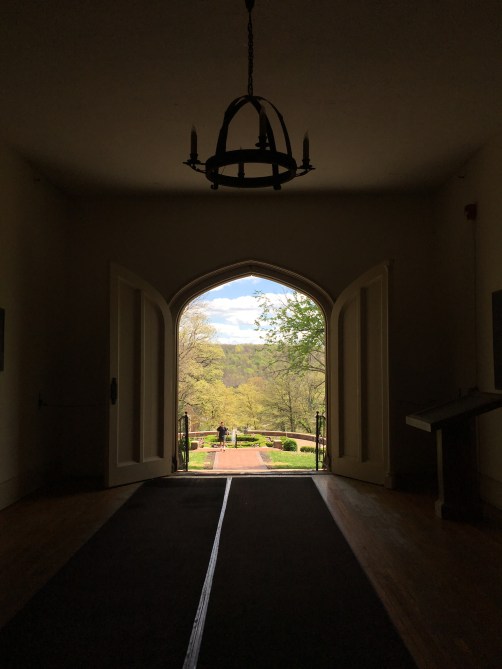
IMG_6767

Looking out on the West Virginian countryside from Old Main at Bethany College
Cultivating the Domain

This first blog post is an excerpt from a chapter I’m working on that analyzes Alexander Campbell’s economic success and how it impacted the Campbellite journey from sect to denomination.

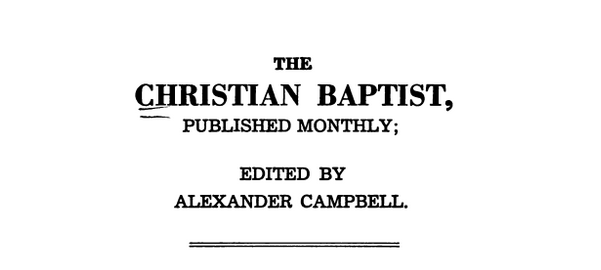
the-christian-baptist

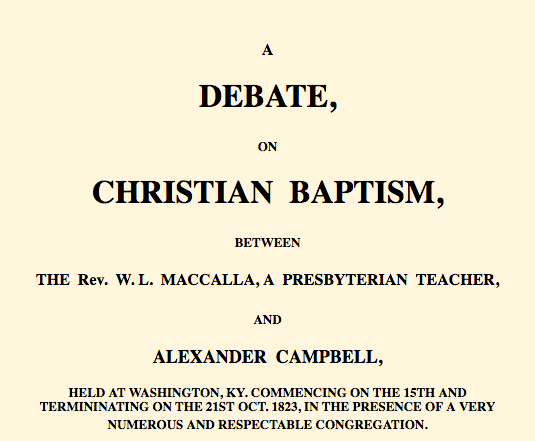
In 1823, Baptists in Kentucky hailed themselves the victors as their champion, Alexander Campbell, disposed of his foe, W.L. McCalla in public debate. So many people attended the debate that it had to be moved from its planned location, the Washington Baptist Church, to the Methodist camp meeting grounds. Kentucky Baptists believed that Campbell was one of them, promoting and defending their cause in the bluegrass. But Campbell had been a hesitant Baptist at best and to avoid the embarrassment of not being selected as a “messenger” for his own congregation and potentially excommunication at the upcoming Association meeting, he had recently orchestrated his own dismissal from the Brush Run Church, a congregation loosely affiliated with the Red Stone Association in Pennsylvania. So when Baptist preachers and lay members cheered Campbell’s success against McCalla, most of them did so without the knowledge that he was in the middle of a growing controversy. Ever the entrepreneur and self-promoter, Campbell shrewdly used this moment to draw attention to his newest venture, his monthly publication the Christian Baptist, and to bring converts to his cause.

a-debate-on-christian-baptism(photo credit: http://www.sidneyrigdon.com/1824cam1.htm)

Baptists commended Campbell’s victory against McCalla and thanked providence for his arrival in Kentucky. Walter Warder, the minister of Washington Baptist Church, exclaimed “It seemed . . . that God had raised up Alexander Campbell for such a time as this.”[1] On the fifth day of the debate, Campbell was so “overwhelmed” by Baptist support that he decided to reveal his position to prominent Baptist preachers and members in his private room. He told them, “Brethren, I fear that if you knew me better you would esteem and love me less. For let me tell you that I have almost as much against you Baptists as I have against the Presbyterians. They err in one thing and you in another; and probably you are each nearly equidistant from original apostolic Christianity.” He paused and, in his telling of it, experienced “a silence . . . [and] a piercing look from all sides of the room, I seldom before witnessed.” The blows Campbell delivered to McCalla, in some regard, paled in comparison to the ones he dealt his Baptist supporters in that room. Reeling and stunned, it was Campbell’s own selected moderator, Jeremiah Vardeman, who broke the silence. He implored Campbell, “. . . we want to know our errors or your heterodoxy. Do let us hear it. Keep nothing back.”[2]

The evidence is compelling that Campbell earnestly believed the message he preached and that his actions were not the work of a swindler. Nevertheless, the moment that followed Vardeman’s request, gives the impression of a calculated measure. Campbell replied that he was tired from the debate and lacked the energy to attempt a task so immense as to verbally explain the numerous Baptist errors. Instead, he suggested an alternate solution, he said “I am commencing a publication called the Christian Baptist, to be devoted to all such matters, a few copies of which are in my portmanteau, and, with your permission, I will read you a few specimens of my heterodoxy.” Those present agreed to listen and, in fact, desperately wanted to know what their erstwhile champion had against them. Campbell went upstairs to his room and returned with ten copies of the Christian Baptist. He distributed the copies, in his words, “among the ten most distinguished and advanced elders in the room.” He asked them to read the periodical during the recess of the debate and to discuss it with him after.

Some of those present agreed with Campbell’s perspective, others remained resolutely opposed, while some vacillated in indecision. This was a signal moment in the beginning of Campbell’s insurgency among the Baptists and in his success as a publisher. In the Baptists, especially those west of the Appalachians, Campbell found a market that was ripe for the taking. As Baptist historian Frank Masters pointed out, there was no state organization, no school, no comparable denominational paper, an untrained ministry, and only a loosely unified group of twenty-five Baptist Associations to combat Campbell’s efforts and teaching.[3] In fact, the unity they did have served Campbell’s ends more than they inhibited them. Before the McCalla debate, Campbell did not have a single reader in Kentucky; shortly after the McCalla debate, he garnered thousands. Campbell’s continued association with Baptists throughout the 1820s – he joined the Mahoning Association after leaving Red Stone – and the lack of any substantial institutional organization to oppose him, allowed him to gain religious followers at the same that he built and grew a relative publishing empire.

[1] Frank M. Masters, A History of Baptists in Kentucky, (Louisville: Kentucky Baptist Historical Society, 1953) 209.

[2] Richardson, Memoirs, vol. II., 88.

[3] Masters, Baptists in Kentucky, 211.